
A denial management director has hundreds of denied claims on her desk, a team of nurses to work them, and 30 days before the appeal window closes. Plenty of AI tools can draft an appeal letter. The real question she needs answered comes earlier: "Which of these should I appeal? Which need a chart review? Which should I let go? And why do the same denials keep coming back?"
These questions are worth millions of dollars. At Anomaly, we work with health systems to answer it. In our collaboration with Inova Health, the team recovered $10.4 million in recovered revenue in the first 90 days, with an estimated $3.8 million in ongoing monthly impact. That impact came from giving Inova's revenue cycle team the right information and matching it to the right action, from appealing a single claim to taking a widespread issue straight to the payer.
As AI investment in revenue cycle management accelerates across the industry, we want to share what we have learned about where the real value lives.
Medical necessity denials are one of the highest-value denial categories in healthcare. Gaps in healthcare claims management specifically related to medical necessity cost health systems $2.5 billion every single year in completely unrecovered or written-off revenue. They are also among the most recoverable, when you know what to do with them. Across the health systems we work with, we see millions of dollars in medical necessity denials, and it is often hard to tell why a claim was denied in the first place. Different vendors may manage different parts of the medical necessity process. Payer policies change often, and those changes do not always reach providers. Denial codes can be too vague to pinpoint the problem.
Recovering that revenue is possible. But it requires knowing three things: which policy actually governs the claim, whether the patient's diagnosis falls within that policy's covered indications for the specific procedure, and what action to take next. That last part, the action, matters more than it might seem.
The most consequential decision in denial management is whether to appeal at all. In our work, we classify every medical necessity denial into one of five action categories:

Getting the appeal-versus-chart-review distinction right is critical. When staff spend the appeal window on a claim whose diagnosis directly conflicts with the payer's published coverage policy, that time is wasted. Every time the system gets this wrong, it costs the health system a real recovery opportunity.
This is the step where AI can add the most value but in our early iterations, this was our biggest source of error, and fixing it is what drove our results from mediocre to production-grade.
A few examples of what makes this hard:
When we first ran our AI-driven policy matching and action classification on real medical necessity denials, our agreement rate with our senior denial management specialist was roughly 55%. The system found relevant policies and produced well-reasoned explanations, but it recommended the wrong action nearly half the time.
The failure modes were specific:
Our specialist reviewed real outputs on real claims, and we codified each correction as a rule, from "dual-eligible is not commercial" to "you cannot directly appeal a claim in conflict with policy" to "this payer delegates imaging review to a specific vendor whose guidelines must be cited." Over multiple review cycles, agreement rose above 90%.
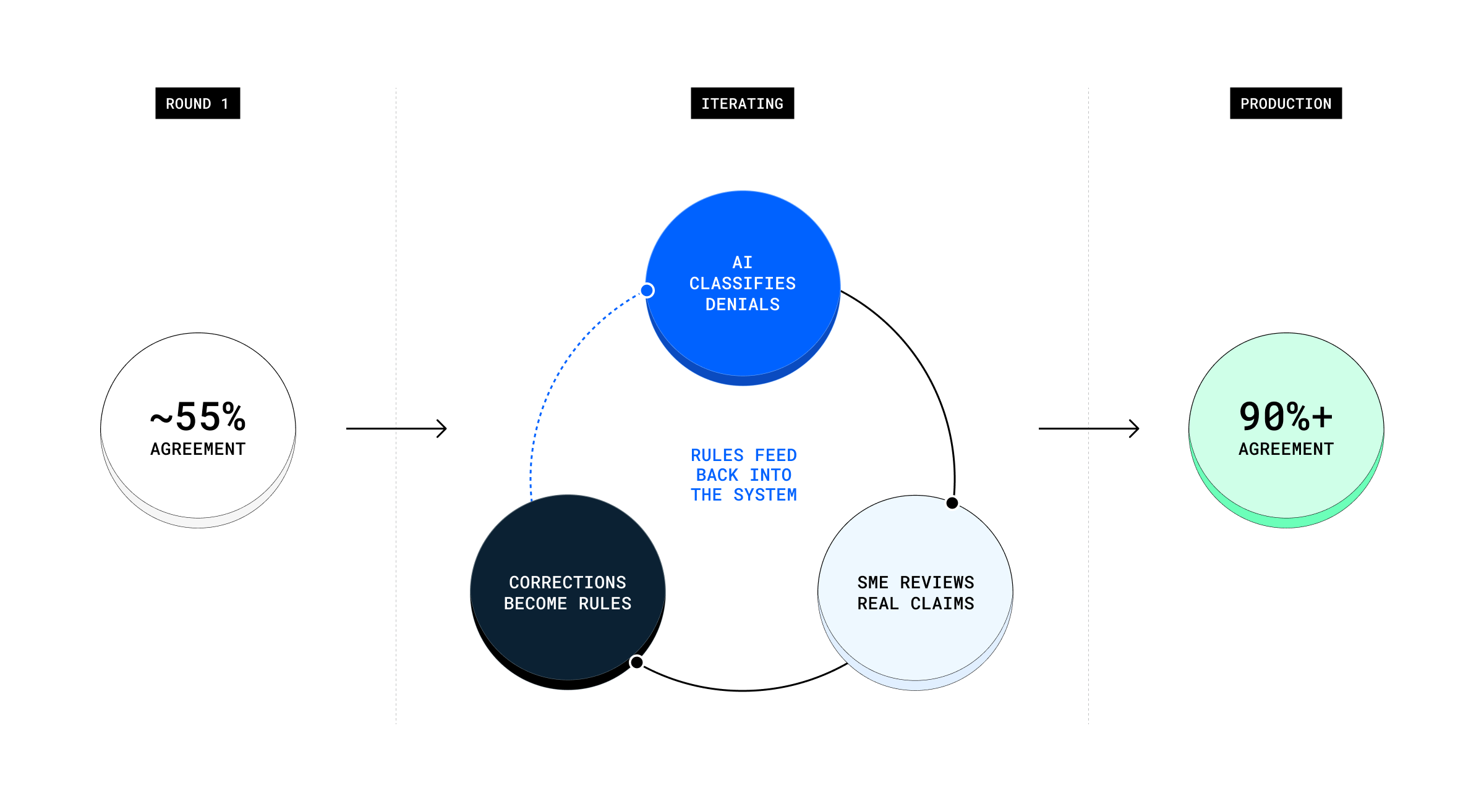
This improvement started with an expert saying, “This is wrong, and here is why.” Today, the system applies those rules automatically to every denial it reviews.
Faster appeals help teams work through the individual denials already in the queue. The real opportunity is using AI to understand why those denials keep happening. With that understanding, health systems can remedy their own processes that are causing denials and know when larger issues need to be addressed with the payer. An appeal resolves a single claim. Working with a payer at the policy and contract level can recover revenue and eliminate future denials at scale. That shift, from working denials claim by claim to fixing the system behind them, is how we build transparency and accountability into healthcare payments.
A payment system built on transparency and accountability frees up revenue that can go back into patient care. Erin Hodson, Inova’s VP of Revenue Cycle, sees that impact firsthand: “Every dollar we recover through this work is a dollar we can reinvest in the patients and communities we serve.”
